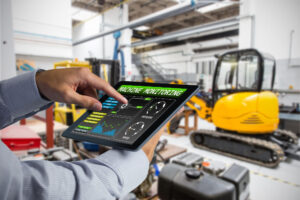
IEEE1588-2 SyncE industrial switches represent a breakthrough in real-time control of complex industrial processes. They enable the synchronization of machinery and sensors with nanometer precision, enabling deterministic coordination on standard Ethernet architectures. They are emerging as a key tool for ultra-high-performance networks in the smart factory.
IEEE1588-2 SyncE Industrial Switch: What is it and how does it work?
IEEE1588-2 SyncE industrial switches represent a fundamental solution for designing and implementing business-critical industrial applications, where precise time synchronization is a must. These switches are specifically designed for critical industrial environments and integrate advanced technologies such as SyncE and the IEEE1588 Precision Time Protocol to ensure highly accurate network clock synchronization.
SyncE technology enables the distribution of a precise, highly stable clock signal across the Ethernet network, while the IEEE1588-2008 (PTP) protocol synchronizes device clocks with nanosecond precision. The accurate time synchronization enabled by these switches is essential for business-critical applications that require real-time control and coordination between machinery, sensors, and distributed systems, such as in industrial automation, utilities, transportation, or telecommunications.
Precise data and event timing allows for the precise monitoring and control of complex industrial processes, execution of automated actions, acquisition of sensor data, and real-time analytics. Designing and deploying business-critical industrial applications requires solutions like SyncE IEEE1588-2 industrial switches to ensure the necessary precision and consistency. SyncE IEEE1588-2 industrial switches are designed with optimized hardware and software to support deterministic PTP packet distribution with minimal latency and jitter, critical for industrial applications requiring high-precision control and synchronization. Their reliability, flexibility, and scalability make them ideal solutions for building deterministic Ethernet architectures for Industry 4.0.
Synchronous Ethernet: The Importance of Synchronization in Industrial Networks
Time synchronization is crucial in industrial networks, where it is necessary to coordinate and synchronize machinery, sensors, and distributed systems that require real-time control. Synchronous Ethernet (SyncE) technology provides the essential tool for distributing a precise and stable clock signal across the industrial Ethernet network. SyncE allows industrial switches to synchronize to a primary time reference source with nanosecond precision.
This time accuracy is essential in business-critical applications that require real-time control and monitoring of complex industrial processes, coordinated execution of actions between interconnected machinery, and simultaneous acquisition of large amounts of data from distributed sensors. SyncE technology is integrated into industrial switches designed for deterministic Ethernet networks, providing the foundation for solutions such as Profinet IRT and TSN that enable isochronous, predictable, and ultra-low-latency communications.
Without accurate clock distribution, applications such as motion control, video surveillance, and product quality control would require complex and expensive proprietary solutions. SyncE enables these business-critical applications using standard Ethernet infrastructures. Designing and implementing deterministic Industrial Networking systems relies on industrial switches with integrated SyncE technology to ensure the required level of synchronization and performance. SyncE-enabled time determination is essential for designing reliable, flexible, and scalable Industrial Ethernet architectures.
Sync Technology and the Benefits of Precise Time Synchronization
SyncE (Synchronous Ethernet) technology provides highly accurate time synchronization, with essential benefits for many critical applications:
1.Real-time Monitoring and Control: Accurate synchronization enables deterministic monitoring and control of complex industrial processes that require coordinated actions and simultaneous data acquisition from multiple sources.
2.Deterministic communication: Packet timing with nanometer precision enables deterministic, predictable, and guaranteed-latency communications, essential in mission-critical systems.
3.Simultaneous data acquisition: Synchronization between sensors and systems allows for the acquisition of large amounts of data from heterogeneous sources with extremely high temporal precision.
4.Real-time data analysis: Accurate timestamping of acquired data enables real-time analysis and immediate anomaly detection.
5.Coordination of machine actions: Common timing between multiple machines allows for the coordination and synchronization of their actions with extreme precision.
6.Open architectures: SyncE enables open, flexible, and interoperable Industrial Ethernet architectures, eliminating the need for proprietary systems.
7.Cost reduction: The use of standard Ethernet networks, made deterministic by SyncE synchronization, reduces infrastructure costs. Industrial Ethernet switches with SyncE support are essential to fully exploit these benefits and design high-performance deterministic communication architectures.