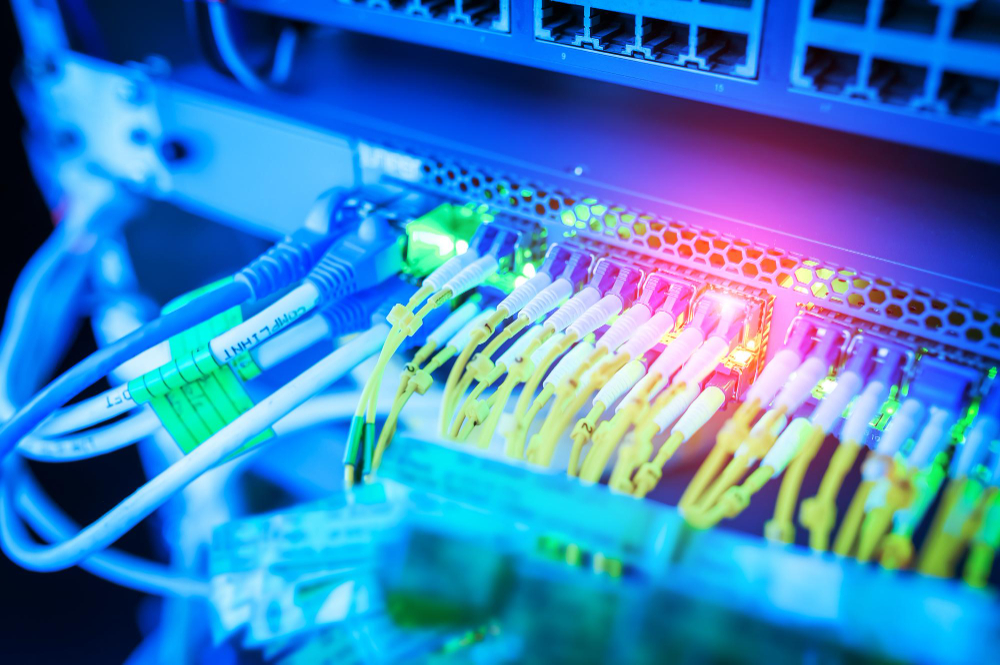
SFP and SFP+ standards are currently the most widely used solution for implementing high-speed optical connectivity in enterprise networks and data centers. Their widespread adoption is driven by the excellent combination of performance, cost-effectiveness, and ease of use these transceivers offer. Performance-wise, SFPs ensure Gigabit connections over a single optical channel, while SFP+s push speeds to 10 Gbps using fiber pairs and sophisticated parallelization techniques. These speeds are sufficient for the vast majority of today’s applications. Cost-wise, SFPs and SFP+s are extremely affordable compared to other 10G solutions such as XFP modules. This makes them the ideal choice for gradually upgrading existing switches without significantly impacting IT budgets. Finally, these transceivers are exceptionally easy to use: their pluggable form factor makes installation and replacement quick and painless, requiring neither dedicated equipment nor network service interruptions.
What is a fiber transceiver and what are the differences between SFP/SFP+?
Fiber optic transceivers are essential components in telecommunications networks that use fiber optics as the transmission medium. They convert electrical signals into optical signals and vice versa, enabling data transmission over fiber. The most common transceivers are SFP and SFP+. SFP (Small Form-factor Pluggable) are compact transceivers that support speeds of up to 1 Gigabit/s. They use a single optical fiber for bidirectional data transmission, employing different wavelengths for upstream and downstream. SFPs are available for copper and fiber optic connections and are widely used in network devices such as switches and routers. SFP+, on the other hand, support higher speeds of up to 10 Gigabit/s, using a pair of optical fibers for full-duplex transmission. Compared to SFPs, they have a slightly larger form factor but are still pluggable, and require high-speed optical modules. SFP+s are primarily used for high-speed interconnections between core network and data center devices. The main difference between SFP and SFP+ is the supported speed—1 Gbps and 10 Gbps, respectively—and the number of optical fibers used. Both allow for the flexible addition of fiber connectivity to network devices. The choice depends on the required performance and available budget. An interesting solution may be the use of fiber transceivers with integrated fiber optic bypass.
Transceivers and the Advantages of Fiber Optics in Industrial Networks
Fiber optics are playing an increasingly important role in industrial network infrastructures, thanks to their unique characteristics that make them ideal for the environments and applications typical of industrial plants. Compared to traditional copper networks, the widespread use of fiber and modern optical transceivers brings significant advantages in terms of performance, reliability, flexibility, and security. Unlocking the full potential of fiber optics in industry requires careful network planning and design, selecting optimal components such as suitable fiber transceivers, and proper infrastructure installation and management. The main advantages of using modern fiber optic networking solutions in industrial environments include: High transmission speed. SFP+ transceivers reach speeds of up to 10 Gbps, ideal for industrial applications requiring high throughput. Immunity to electromagnetic interference. Fiber optics are not affected by electrical or radio frequency interference, unlike copper. This makes them ideal for critical industrial environments. Secure communications. Fiber optic networks are inherently more secure and difficult to intercept than copper networks. Greater reliability. Fiber cables have a longer lifespan and require less maintenance than copper. Less downtime for industrial equipment. Flexible deployment. SFP/SFP+ transceivers allow you to modularly add optical ports to industrial switches. Easy to install and replace. Support for long-distance transmissions. Fiber can cover distances exceeding 100 km without signal regeneration, ideal for large industrial facilities. Greater bandwidth. Fiber supports much higher bandwidths than copper, allowing for the transmission of large amounts of data. Electrical isolation. No current flows between fiber-connected devices, improving plant safety. Reduced cable clutter. Fiber optic cables are much thinner and lighter than copper, simplifying installation in industrial environments. Support for critical applications. Fiber is ideal for controlling industrial machinery that requires low latency and jitter. To fully leverage the benefits of fiber transceivers and optical networks in industrial environments, fiber network design, implementation, and deployment by a partner with expertise in the field is essential.
Transceivers and Applications in Network Infrastructure
In industrial networks, fiber optic transceivers play a key role in several areas. First and foremost, they enable high-speed interconnections between industrial machinery, control systems, and supervisory stations. Industrial switches are typically equipped with SFP and SFP+ ports to provide optical uplinks to the hierarchically higher network layer. Transceivers enable point-to-point fiber connections between even very distant industrial sites, thanks to fiber’s ability to transmit for tens of kilometers without signal regeneration. They are also used to connect field machinery and sensors to the industrial Ethernet network, allowing for widespread connectivity. For example, rugged field switches can feature SFP ports to interface with field equipment. Optical transceivers are also the foundation of augmented reality and predictive maintenance applications that leverage ultra-high-speed, ultra-low-latency networks. Therefore, in industrial automation and control infrastructures, fiber transceivers are essential components to fully exploit the benefits of fiber optics.